Executive summary about NIRF Ranking 2026
This article explains what the National Institutional Ranking Framework (NIRF) is, why it matters for Indian higher-education institutions, how to register and submit data on the official portal, the eligibility rules and categories, the precise types of data and documentary evidence commonly required, and practical recommendations to prepare a robust submission. All procedural claims and technical metrics are sourced from NIRF’s official documents and the India Rankings reports
What is NIRF and why it matters
NIRF Ranking 2026: The National Institutional Ranking Framework (NIRF) is the Government of India’s official ranking methodology for higher-education institutions. Launched by the Ministry of Education (MoE) in 2015, NIRF provides an objective, metric-based assessment to compare institutions across categories (Overall, Universities, Engineering, Management, Pharmacy, Law, Medical, Colleges, Research Institutions, and others). The framework aims to promote transparency, incentivize quality, and provide stakeholders—students, parents, employers and policy-makers—with a reliable reference.
The primary policy objective behind NIRF was twofold: first, to provide a reliable and domestically relevant tool for students, parents, and employers to make informed decisions about institutional quality; and second, to foster a culture of healthy competition among institutions, encouraging them to improve their performance across key metrics.
This initiative was also a strategic response to the often-debated performance of Indian universities in global ranking systems, aiming to build an institutional evaluation framework that considers the specific socio-economic context and national priorities of India.
Listen to Audio Podcast to understand NIRF (in Hindi)
Listen to Audio Podcast to understand NIRF (in English)
NIRF ranking categories and recent expansions
NIRF publishes rankings in multiple categories (Overall, Universities, Colleges, Engineering, Management, Medical, Pharmacy, Law, Architecture & Planning, Dental, Research, Innovation, Agriculture & Allied Sectors, Open/Skill/State Public Universities, SDG/Sustainable Development Goals, etc.).
The number of categories has expanded over successive editions to reflect sectoral diversity; the India Rankings reports list category-wise methods and ranked institutions for each year.
How NIRF Rankings are Calculated: The Five Pillars of Assessment
Teaching, Learning & Resources (TLR)
This parameter assesses the foundational academic quality of an institution. It includes metrics such as total student strength and Ph.D. student numbers, the faculty-student ratio (with an emphasis on permanent faculty), the combined metric for faculty qualifications (Ph.D. or equivalent) and experience, and the financial resources available and their utilization.
Research and Professional Practice (RP)
This pillar measures the institution’s research output, impact, and its ability to translate that research into practical application. It includes metrics for the combined volume of publications, the quality of publications (citations), IPR (Intellectual Property Rights) in the form of patents granted and published, and the “footprint” of sponsored research projects and professional practice.
Graduation Outcomes (GO)
This parameter evaluates the ultimate success of an institution’s students, acting as a “test of the effectiveness” of the core teaching and learning. Metrics under GO include the percentage of students who successfully complete their university examinations, the number of Ph.D. students who graduate, and, in several categories, metrics for placements and median salaries.
Outreach and Inclusivity (OI)
This pillar measures the institution’s performance on social equity, diversity, and public engagement. It includes metrics for the percentage of students from other states or countries (regional diversity), the percentage of women students and faculty (women diversity), the inclusion of economically and socially challenged students (ESCS), and the provision of facilities for differently-abled students.
Perception (PR)
This parameter gauges the institution’s reputation and standing in the wider community. This score is derived from surveys of a large group of academic peers and employers, who are asked to rate their preference for graduates from different institutions.
Deconstructing the "Weights": How Scores are Balanced
| Parameter | ‘Overall’ Category (Weightage) | ‘Engineering’ Category (Weightage) | ‘Colleges’ Category (Weightage) | Analyst’s Insight on the Difference |
| Teaching, Learning & Resources (TLR) | 0.30 (30%) | 0.30 (30%) | 0.40 (40%) | Colleges are weighted 10% more on TLR, reflecting their primary mission as teaching-focused undergraduate institutions. |
| Research & Professional Practice (RP) | 0.30 (30%) | 0.30 (30%) | 0.15 (15%) | The RP weightage is halved for Colleges, acknowledging that high-volume, publication-centric research is not their primary function, unlike in a University or Engineering institution. |
| Graduation Outcomes (GO) | 0.20 (20%) | 0.20 (20%) | 0.25 (25%) | GO is weighted slightly higher for Colleges, placing a greater emphasis on student success, pass rates, and progression to higher studies or employment. |
| Outreach & Inclusivity (OI) | 0.10 (10%) | 0.10 (10%) | 0.10 (10%) | This parameter is consistently weighted at 10% across these categories, signaling a uniform national policy priority for diversity and inclusivity. |
| Perception (PR) | 0.10 (10%) | 0.10 (10%) | 0.10 (10%) | Reputation is given a consistent 10% weight, maintaining its role as a significant, but not dominant, factor in the final score. |
Eligibility Check
Part 1: Are You Eligible? NIRF Eligibility Criteria
Before beginning the registration process, an institution must meet several key eligibility criteria.
General Eligibility:
Type of Institution: Participation is open to Universities (Central, State, Private, and Deemed-to-be), Institutes of National Importance (like IITs, IIMs, NITs), and Colleges (including stand-alone professional institutions) that are affiliated with a university.
Operational Status: The institution must have been operational for at least three academic years. Some institutions, as a practical matter, choose to wait until they have graduated at least three batches of students before participating.
Regulatory Approval: The institution must be recognized and approved by relevant statutory bodies, such as the University Grants Commission (UGC) or the All India Council for Technical Education (AICTE).
Discipline-Specific & Category-Based Eligibility:
NIRF classifies institutions into two main categories for ranking: Category A (Institutions engaged in Research and Teaching, such as Universities, INIs, and Autonomous Colleges) and Category B (Institutions engaged primarily in Teaching, which includes most affiliated colleges).
A critical and often misunderstood rule is that for a specific school or department within a larger university (e.g., the Faculty of Law, the Department of Management, or the School of Engineering) to be ranked in its specific discipline, it must register separately. This separate registration requires the submission of additional, discipline-specific data. This is a vital strategic decision for universities wishing to highlight the national standing of their individual faculties.
Part 2: The Registration and Data Submission Workflow
The annual participation cycle follows a structured timeline and set of procedures.
Step 1: Registration on the NIRF Portal:
The process begins when NIRF opens its annual registration window. New institutions must visit the NIRF registration portal to create an account. Institutions that have participated in previous years are often “pre-registered” and sent invitations to participate in the new cycle.
Step 2: Appointment of the Nodal Officer:
This is a formal and mandatory step. Each participating institution must nominate one of its senior functionaries to serve as the official Nodal Officer. This individual becomes the single point of contact for all NIRF matters and bears significant responsibility for the institution’s submission.
Step 3: Data Submission via the Data Capturing System (DCS):
Once registered, the Nodal Officer is given access to the online Data Capturing System (DCS). This is the interface through which the institution will submit all the exhaustive data required for the ranking parameters, typically covering the previous three academic years.
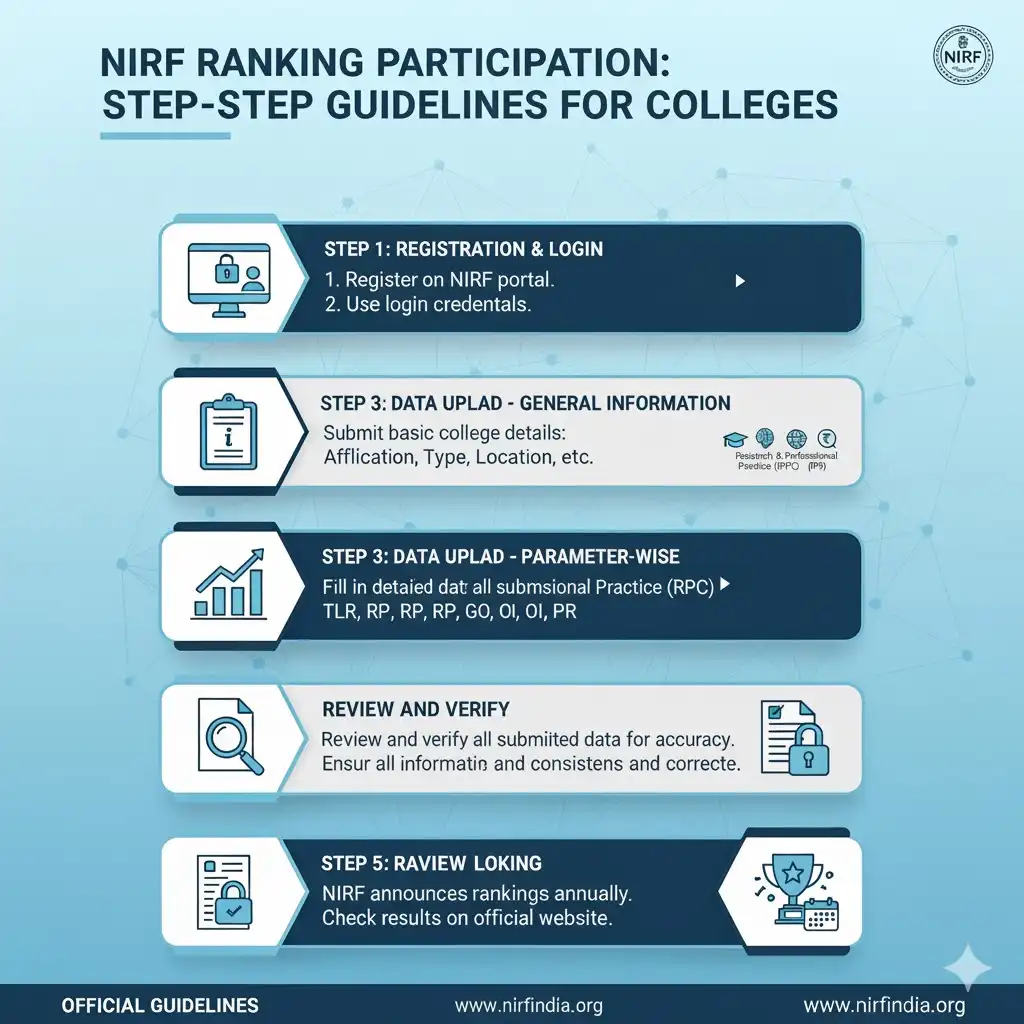
How to register: step-by-step (official portal workflow)
Registration and data submission are conducted via the NIRF online portal (login.nirfindia.org). The high-level steps:
- Pre-registration / login: Use the NIRF login portal. Returning institutions use the existing Overall ID and password; new institutions must create an account (overall ID).
- Confirm participation and select categories: After login, confirm participation for the relevant India Rankings year and choose categories/domains (Overall, Engineering, Management, etc.).
- Download the XL utility / offline template: NIRF provides Excel templates (XL Utility) and a user manual. Institutions are advised to prepare data offline in the prescribed formats, then upload via the portal.
- Complete data entry and attach supporting documents: Enter data across parameter-wise tabs, and upload documentary evidence (audited accounts, appointment letters, PhD award lists, placement records, patents, project letters, published papers lists with DOI/Scopus/Web of Science IDs where applicable).
- Self-declaration and submit: A designated Nodal Officer signs the declaration. Institutions must host the submitted data on their institutional website (a prominent “NIRF” link) for transparency and remain responsive to queries/corrections within the window announced by NIRF. Failure to host or cooperate may invite actions including debarment.
Important operational note: Deadlines for registration and final submission vary annually and are published on the NIRF portal; monitor the portal for the specific India Rankings cycle.

Exact types of data and documentary evidence required
NIRF collects structured data mapped to every metric. The exact data fields vary by category, but the following lists cover the core items institutions must compile and verify.
Institutional identity & governance
- Legal status (University/Deemed/Private/Autonomous/Affiliated college), affiliation details, recognition letters (UGC/AICTE/MCI/DCI etc.).
- Governing body composition, Deans/HoDs list.
(Use: registration form fields + statutory documents.)
Student-related data
- Sanctioned intake by program & academic year (last 5 years).
- Actual student strength (current and over historical years).
- Number of students graduating per program and year.
- Placement details: number of students placed, median salary, qualifying exam success (GATE/CAT/NEET etc.) where applicable.
(Supporting evidence: exam result lists, placement offer letters, placement report, convocation lists.)
Faculty data
- Faculty count (regular, contract, visiting), qualification (PhD vs. M.Tech/MPhil), experience, papers supervised (PhD supervisors), faculty joined and left (yearly).
- Faculty-to-student ratio and credits assigned.
(Supporting evidence: appointment orders, PhD award letters, HR records.)
Research, professional practice and projects
- Publications (year-wise, with bibliographic identifiers: DOI, Scopus/WoS IDs where possible), citations, h-index indicators.
- Sponsored research projects (sponsor, amount, duration), consultancy income, professional practice outputs.
- Patents filed/granted (application numbers, grant certificates).
- Research awards and PhD completions.
(Supporting evidence: project sanction letters, copies of journal DOIs, patent documents.)
Financial and resource data
- Annual audited financial statements (income & expenditure), capital expenditure on academic facilities, per-student expenditure.
- Library holdings (books, journals, e-resources), lab and IT infrastructure metrics.
(Supporting evidence: audited reports, financial statements, purchase orders.)
Outreach, diversity and inclusivity
- Enrollment and scholarship data for SC/ST/OBC/Minorities, women, economically weaker sections, and regional inclusion metrics.
- Community outreach programs and extension activities (MoUs, program reports).
(Supporting evidence: program reports, scholarship disbursement records.)
Perception evidence
- NIRF perception surveys are populated from peers and employers. Institutions should collate recognized employer interactions and archival records that demonstrate employer engagement (MOUs, placement company lists).
User manual & data definitions — where to find them and why they matter
NIRF publishes a User Manual / Data Definitions document (e.g., User_Manual_IR_24.pdf) that provides field-level definitions, example screenshots, and the expected format for each input field (e.g., how to count faculty FTEs, how to report multi-year project amounts). Rigorously follow the manual: many errors and rejections are due to inconsistent interpretation of definitions.
Quality control, transparency and compliance requirements
- Host submitted data on your institutional website under a prominent “NIRF” link for at least three years; the portal requires this as a transparency measure. NIRF may call for corrections post-submission; institutions must respond.
- Auditability: NIRF reserves the right to verify records (including physical audits). Non-cooperation or detected misreporting can lead to debarment and public disclosure of unethical behaviour.
- Use authoritative bibliographic sources: For publications and citations, provide DOIs and publisher indexing references; where automated population is used, reconcile portal values with institutional records.
Common pitfalls and how to avoid them
- Inconsistent definitions: Not following the NIRF User Manual (e.g., double counting faculty or students) — mitigation: adopt the official data dictionary and run internal reconciliation.
- Poor documentary linkage: Providing data without verifiable supporting documents — mitigation: attach scanned, notarised or digitally signed source documents and maintain a central evidence repository.
- Missing data hosting: Failing to host submitted data on institutional website — mitigation: publish immediately after submission and archive.
- Perception weakness: Low peer/employer perception scores — mitigation: strengthen industry engagement, alumni outreach, and collaborate on visible industry projects.
Practical timeline and institutional resourcing
- Preparation (3–6 months prior): Compile five-year historical data, audited accounts, publications list, PhD awards, placement evidence. Assign a dedicated Nodal Officer and a small team (academics + finance + registrar + librarian + IT).
- Data compilation (1–2 months prior): Fill Excel templates, cross-verify numbers against official registers and financials, prepare PDFs of evidence.
- Portal submission (as per published window): Upload and finalize. Keep communications open for clarification windows post-submission.
NIRF vs. NAAC: Understanding the Difference
A common point of confusion for students, parents, and even administrators is the distinction between India’s two premier quality assessment systems: NIRF and NAAC. It is essential to understand that these two systems are not competitors; they are complementary tools designed for different, though related, purposes.
- NAAC (National Assessment and Accreditation Council): This body provides Accreditation. Accreditation is a process-oriented, qualitative, and peer-reviewed assessment of an institution’s quality systems. NAAC assesses an institution’s potential and its internal processes (like governance, curriculum design, and infrastructure), awarding it a Grade (e.g., A++, A+, B) that is typically valid for five years.
- NIRF (National Institutional Ranking Framework): This system provides a Ranking. Ranking is an outcome-oriented, quantitative, and data-driven assessment of an institution’s performance. NIRF ranks an institution’s performance against its peers on an annual basis using hard metrics like placements, median salaries, and publication counts
Feature | NIRF (Ranking) | NAAC (Accreditation) |
Primary Goal | To rank institutions competitively (Outcome-Oriented) | To assess and grade institutional quality (Process-Oriented) |
Focus | Quantitative performance (placements, research output) | Qualitative processes (governance, curriculum, infrastructure) |
Output | A numerical rank (e.g., #1, #2, #10) | A letter grade (e.g., A++, A+, B) |
Frequency | Annual | 5-year cycle |
Comparison | Institution vs. Institution (Competitive) | Institution vs. Fixed Standards (Self-Assessment) |
Frequently Asked Questions (FAQs)
How can I check my college's NIRF ranking?
You can check the official NIRF website (https://www.nirfindia.org/). Rankings are published annually and are available by category (Overall, University, College, Engineering, etc.).
Is a high NIRF rank good for placements?
Yes. “Graduation Outcomes,” which includes metrics like placements and median salary, is a significant parameter in the ranking. A high rank is also a credible signal of quality that employers recognize, which can lead to better career opportunities.
What are the 5 main parameters of NIRF?
The five core parameters are: 1) Teaching, Learning & Resources (TLR), 2) Research and Professional Practice (RP), 3) Graduation Outcomes (GO), 4) Outreach and Inclusivity (OI), and 5) Perception (PR).
How is the NIRF ranking score calculated?
The final score is a weighted average of the scores from the five parameters. Data is collected from the institutions themselves via the Data Capturing System (DCS) and from third-party sources like Scopus and Web of Science for research metrics.
What is the difference between NIRF and NAAC?
NIRF is an annual, competitive ranking system that compares institutions against each other based on quantitative outcomes (like placements). NAAC is a 5-year accreditation system that gives an institution a grade based on its internal processes and quality standards.
What are the benefits of NIRF ranking for my college?
A high rank can significantly improve an institution’s brand and reputation, which helps in attracting better students and faculty. Most importantly, it leads to concrete benefits like increased government/private research funding and stronger industry collaborations.
What is the role of a Nodal Officer in NIRF?
The Nodal Officer is a senior official nominated by the institution to be the single point of contact for NIRF. They are legally responsible for submitting, verifying, and ensuring the authenticity of all data provided to NIRF.
Useful official links and documents
- NIRF official home page: https://www.nirfindia.org/.
- Registration / login portal: https://login.nirfindia.org/ (create Overall ID / pre-registration).
- Registration instructions (reg_instruction.pdf): details on pre-registration, XL utility and category rules.
- User Manual and Data Definitions (User_Manual_IR_24.pdf): field-level guidance and screenshots.
- India Rankings Report and discipline frameworks (IR2024/IR2025 reports & discipline PDFs): methodology, category weights and exemplars.
By subscribing to our newsletter you agree to receive recent updates related to the educational field, personal skill improvements and latest updates from our websites.
Get
- NIRF Evidence And Audit Checklist
- NIRF Compliance Manual
- NIRF Designed Evidence Audit
- NAAC-Aligned NIRF Readiness
- NIRF SOP and
- NIRF Checklist directly to your email.
All these important documents in your email.
Subscribe to our newsletter now (Click here)
(By subscribing to our newsletter you agree to receive recent updates related to the educational field, personal skill improvements and latest updates from our websites.)
Also read about Unnat Bharat Abhiyan: Complete Guide to College Registration, Village Adoption & Objectives (2025)